
Temulawak Extract: Why Does Curcuminoid Standardization Matter?
Curcuma xanthorrhiza Roxb., known as temulawak in Indonesia, is a medicinal plant valued for its various bioactive compounds.
When choosing a herbal extract, a higher extract ratio may seem like an indicator of better quality or potency. However, the extract ratio alone does not necessarily reflect the concentration of specific active compounds in the final product.
At Ananta, we believe that selecting a herbal extract should go beyond comparing extract ratios and prices. The actual content of relevant compounds is an important factor to consider when evaluating extract quality.
A Surprising Finding from the Market
After evaluating several temulawak extract products available on the market, we were surprised to discover significant differences in their curcuminoid content.
Some products with similar or even higher prices contained considerably lower levels of curcuminoids. This finding highlights an important consideration: a higher extract ratio or price does not automatically mean a higher active compound content.
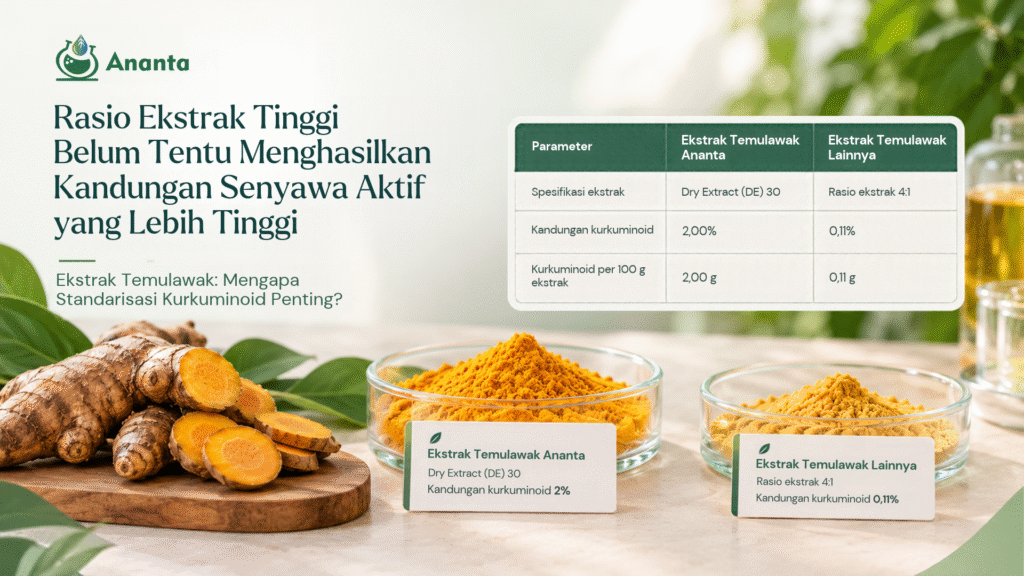
To illustrate this, consider the following comparison between two products:
| Parameter | Extract Ananta | Extract B |
| Extract specification | DE 30 | Extract ratio 4:1 |
| Curcuminoid content | 2.00% | 0.11% |
| Curcuminoid per 100 g of extract | 2.00 g | 0.11 g |
Note: These figures represent a specific product comparison based on the data available for this article. They should not be interpreted as representative of all temulawak extracts with these specifications.
Based on the figures, Extract Ananta contains approximately 18 times more curcuminoids by weight than Extract B.
Despite the difference in measured curcuminoid content, products such as these may have similar or even higher prices. Therefore, evaluating a herbal extract based solely on its price or extract ratio may not provide a complete picture of its value.
Understanding Extract Ratio and Active Compound Content
An extract ratio, such as 4:1, generally describes the relationship between the amount of starting herbal material and the amount of extract obtained. However, it does not directly indicate the concentration of a particular compound in the finished extract.
The final concentration of active compounds can vary depending on factors such as raw material characteristics, extraction conditions, processing methods, and product specifications.
As a result, two extracts can differ substantially in their active compound content, even when their product descriptions or extraction specifications appear comparable.
This is why extract ratio should be considered alongside analytical results and other relevant quality parameters.
Why Does Curcuminoid Standardization Matter?
Temulawak (Curcuma xanthorrhiza Roxb.) contains various phytochemicals, including curcuminoids, terpenoids, and other phenolic compounds. [1]
When curcuminoid content is an important requirement for a formulation, a clearly defined and verified specification helps manufacturers assess whether an extract meets their intended raw material requirements.
Standardization also supports more consistent evaluation of raw materials across batches and suppliers. The World Health Organization emphasizes the importance of appropriate marker substances in the quality control of herbal medicines. [2]
Rather than assuming that a higher extract ratio guarantees a higher concentration of a particular compound, manufacturers should verify the relevant content through appropriate analytical testing.
What Should You Consider When Selecting a Herbal Extract?
To make a more informed purchasing decision, consider the following parameters:
- Active compound content: Check the measured concentration of the compound relevant to your formulation.
- Standardized specifications: Confirm that the extract has clearly defined requirements for the relevant marker compound.
- Certificate of Analysis (CoA): Review the analytical results and verify that they meet your quality requirements.
- Other quality parameters: Consider moisture content, particle size, microbiological limits, appearance, and other specifications relevant to your application.
- Price versus value: Evaluate the price in relation to the required active compound content and the overall product specifications.
Herbal extract quality should be assessed through relevant analytical tests and product specifications, rather than relying on a single parameter. [2][3]
Choose an Extract Based on What Your Formula Needs
At Ananta, we understand that every formulation has different requirements. Looking beyond extract ratios and evaluating measurable quality parameters can help manufacturers make more informed decisions when selecting herbal extract ingredients.
Looking for Customized Temulawak Extract?
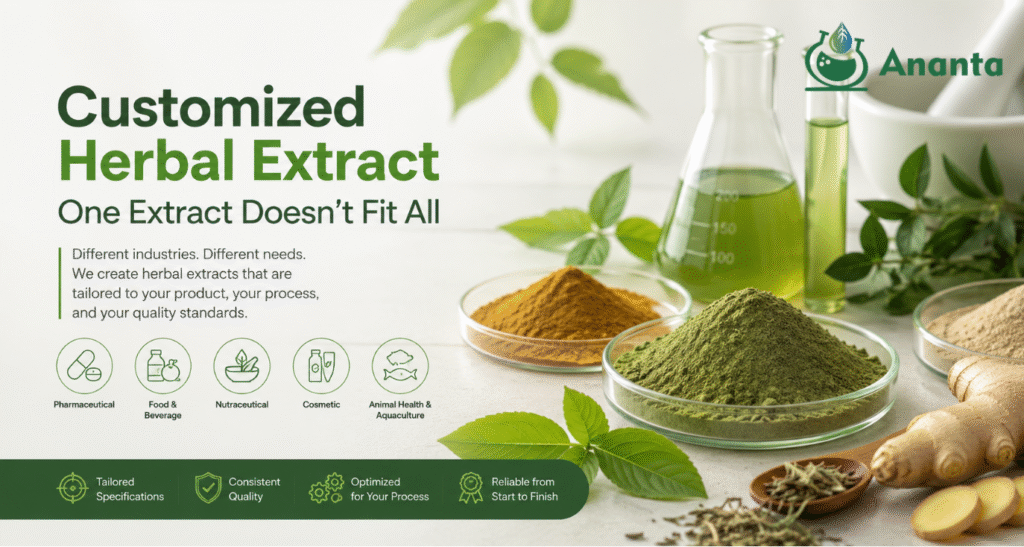
Ananta provides herbal extract solutions tailored to your specific formulation requirements, from botanical sourcing and extraction to customized specifications and quality parameters.
Ananta — Provide Herbal Extract Solution as Unique as You Need.
Source ::
- Rahmat, E., Lee, J., & Kang, Y. (2021). Javanese Turmeric (Curcuma xanthorrhiza Roxb.): Ethnobotany, Phytochemistry, Biotechnology, and Pharmacological Activities. Evidence-Based Complementary and Alternative Medicine. https://doi.org/10.1155/2021/9960813
- World Health Organization. (2017). WHO Guidelines for Selecting Marker Substances of Herbal Origin for Quality Control of Herbal Medicines. https://www.who.int/publications/m/item/trs1003-annex1
- European Medicines Agency. Guideline on Specifications: Test Procedures and Acceptance Criteria for Herbal Substances, Herbal Preparations and Herbal Medicinal Products. https://www.ema.europa.eu/en/scientific-guidelines/specifications-test-procedures-acceptance-criteria-herbal-substances-herbal-preparations-herbal-medicinal-products-traditional-herbal-medicinal-products