
Hypertension is a condition characterized by elevated blood pressure and can increase the risk of complications affecting organs such as the heart, brain, and kidneys. Because hypertension often has few noticeable symptoms, it is commonly referred to as a “silent killer.”
Noni, or in indonesian we call it Mengkudu (Morinda citrifolia L.) is a tropical plant traditionally used in Indonesia and has attracted attention for its potential role in supporting blood pressure management.
A literature review published in Jurnal Farmasi dan Herbal reviewed previous studies on Mengkudu and its potential as an antihypertensive. The review compared different studies involving Mengkudu preparations, including juice, fruit extracts, and other processed forms.
What Does the Research Say?
The literature review found that several previous studies reported a significant reduction in blood pressure following the administration of Mengkudu preparations.
In one study involving elderly individuals with hypertension, the average blood pressure before intervention was 167/97 mmHg, while after administration of Mengkudu juice, the average blood pressure decreased to 158/93 mmHg. The study reported a significant reduction in both systolic and diastolic blood pressure.
Another study reported an average reduction of 12 mmHg in systolic blood pressure and 5 mmHg in diastolic blood pressure after administration of Mengkudu fruit juice. Statistical testing resulted in a p-value of 0.015, indicating a significant difference between the treatment and negative control groups.
Research involving adult men with hypertension also reported a reduction in blood pressure. The average blood pressure decreased from 157.78/101.11 mmHg before administration of Mengkudu fruit extract to 149.44/92.22 mmHg after treatment.
These findings suggest that Mengkudu has potential as a botanical ingredient for supporting blood pressure management, although the evidence reviewed involves different preparations and study populations.
Which Compounds May Contribute to Its Antihypertensive Potential?
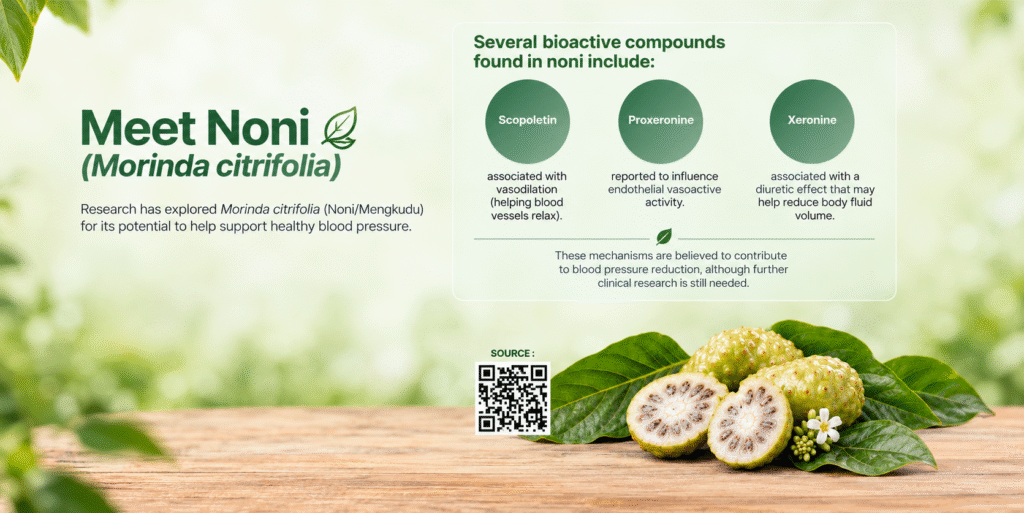
The literature review identifies several compounds in Mengkudu that may contribute to its effects on blood pressure, particularly prexeronin, scopoletin, and xeronine.
1. Scopoletin
Scopoletin is described in the review as having a vasodilatory effect.
Vasodilation refers to the widening of blood vessels. By relaxing or widening blood vessels, vascular resistance may decrease, which can contribute to a reduction in blood pressure. The review also notes that scopoletin may interact with serotonin, an important chemical messenger in the body.
2. Prexeronin
The review describes prexeronin as a compound associated with endothelial vasoactive activity.
According to the reviewed literature, prexeronin may contribute to blood-pressure-lowering effects through its interaction with vasoactive mechanisms in the endothelium.
3. Xeronine
The review also discusses xeronine, which is associated with a diuretic effect.
A diuretic effect can increase urine output and reduce the volume of fluid in the body. The review describes this mechanism as potentially contributing to a reduction in peripheral resistance and, consequently, blood pressure.
Why Is the Mechanism Interesting?
One interesting aspect of Mengkudu is that its potential antihypertensive activity may involve more than one mechanism.
The reviewed literature associates Mengkudu with:
- Vasodilation through scopoletin
- Vasoactive endothelial effects associated with prexeronin
- Diuretic effects associated with xeronine
Together, these mechanisms provide a possible explanation for the blood-pressure-lowering effects reported in several studies.
However, these mechanisms should be interpreted as findings described in the reviewed literature rather than as evidence that Mengkudu can replace established antihypertensive treatment.
Potential Applications
Based on the studies reviewed, Mengkudu may be explored as a botanical ingredient for:
- Herbal and botanical products
- Functional food and beverage concepts
- Nutraceutical formulations
- Botanical ingredient research and development
- Formulations focused on cardiovascular health
The review describes several traditional and processed forms of Mengkudu, including juice, herbal preparations, tea made from dried fruit, and fruit extracts.
For ingredient development, however, the specific form of Mengkudu extract, extraction process, dosage, and standardization parameters should be considered carefully because the studies reviewed used different preparations.
From Traditional Botanical to Functional Ingredient
The literature surrounding Morinda citrifolia highlights an interesting combination of phytochemicals and potential mechanisms associated with blood pressure.
Rather than focusing on a single compound, the reviewed literature points to several compounds—including scopoletin, prexeronin, and xeronine—that may contribute through different pathways.
For manufacturers, understanding the botanical source, extraction method, and desired extract specifications can help support the development of consistent Mengkudu ingredients for specific applications.
At the same time, the available evidence should be interpreted carefully. The reviewed studies involved different forms of Mengkudu and different research populations, including human and animal studies. Further research would be needed to establish standardized efficacy, appropriate dosage, safety, and effectiveness for specific product applications.
Looking for Customized Mengkudu Extract?
Ananta provides herbal extract solutions tailored to your specific formulation requirements—from botanical source and extraction to customized specifications and quality parameters.
Source
Wahyudi, Ingraini, C., Puspita, C., & Luthfiah, M. (2022). Buah Mengkudu (Morinda citrifolia), Kandungan dan Efektivitasnya sebagai Antihipertensi: Literature Review. Jurnal Farmasi dan Herbal, Vol. 4 No. 2, November 2021–April 2022, pp. 102–108.